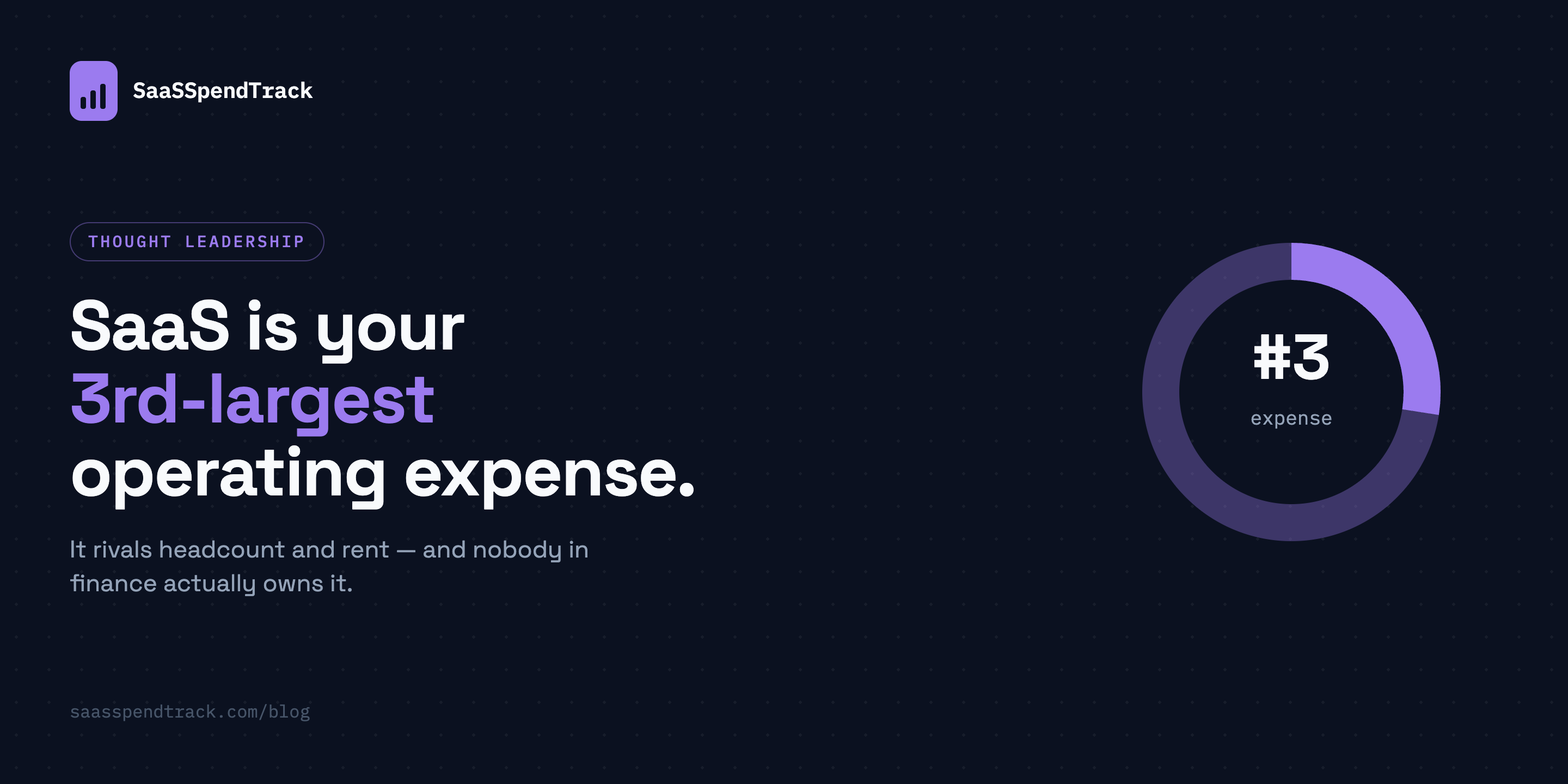
The CFO's Blind Spot: Why SaaS Is Now Your Third-Largest Operating Expense (and Nobody Owns It)
Headcount. Office space. Software. For most growing companies, SaaS has quietly climbed into the top three operating expenses- without a single person or team responsible for managing it.
The Expense Line Nobody Budgeted For
Five years ago, software was a rounding error in most company budgets. You had an email provider, a CRM, maybe a project management tool. The total rarely exceeded $20,000 per year for a mid-size team.
In 2026, the picture looks radically different. SaaS has evolved from a discretionary purchase into a core operating expense that touches every department, every workflow, and every employee. The average growing company now runs 50–100 active software subscriptions, and SaaS spending across industries continues to rise at a compounding rate.
Yet most finance teams still manage this expense the way they managed it when it was small: forwarded invoices, sporadic spreadsheet updates, and a general sense that "someone" is keeping an eye on things. The problem isn't negligence. It's that SaaS purchasing grew faster than the processes designed to govern it.
The Ownership Vacuum
Ask any CFO who owns SaaS spend in their organization and you'll get one of three answers, none of them satisfying:
"IT manages the tools." Technically true- IT provisions access and handles security. But IT doesn't control the budget, doesn't approve purchases, and often doesn't even know about tools that departments buy with their own credit cards. IT sees the access layer, not the spend layer.
"Finance pays the invoices." Also technically true. Finance processes the charges, categorizes the expenses, and includes them in the P&L. But finance sees a line item called "Software- $47,200" without context about what each tool does, who uses it, whether it duplicates another subscription, or whether the contract is about to auto-renew at an inflated rate.
"Department heads choose their tools." This is where the purchasing actually happens. Marketing buys marketing tools. Engineering buys engineering tools. Sales buys sales tools. Each head makes reasonable decisions for their team- but nobody has a view across all departments to spot the overlap, waste, or negotiation opportunities.
A renewal notice arrives 15 days before a contract auto-renews with a 22% price increase. Finance assumed IT was tracking it. IT assumed the original buyer was tracking it. The original buyer left the company in March. The contract renews untouched- and the cycle repeats across dozens of vendors every year.
This is the ownership vacuum. Three teams touch SaaS spend, but none of them own it end-to-end. The result isn't malice- it's structural. And it bleeds money at a rate that would trigger an audit if it showed up in any other expense category.
Why Traditional Finance Controls Don't Work for SaaS
Finance teams are excellent at managing predictable expenses. Payroll runs on a schedule. Rent is a fixed contract. Hardware is a capital expense with a depreciation schedule. SaaS breaks all of these models simultaneously.
SaaS is variable by design
Per-seat pricing means costs fluctuate with headcount. Usage-based tiers mean costs change with adoption. Multi-year contracts with escalators mean the price today isn't the price tomorrow. A single vendor relationship can involve three different pricing models across three different products- and each one can change at renewal.
SaaS is decentralized by default
Unlike hardware purchases that go through procurement, most SaaS tools start as a free trial or a credit card charge. By the time finance sees the expense, the tool is already embedded in a team's workflow. Asking "why do we need this?" three months after adoption feels adversarial rather than strategic. The purchasing decision has already been made; finance is just paying the bill.
SaaS compounds silently
No single subscription looks expensive. $50/month for a productivity tool. $200/month for a design platform. $500/month for analytics. Each one is justified. But fifty justified subscriptions at an average of $300/month is $180,000 per year- and that's before the enterprise tools that cost $15K–$50K annually.
The challenge for 2026 lies in translating SaaS investment into measurable value by improving visibility, optimizing licenses, and proactively managing renewals. SaaS management is no longer a back-office function- it's a strategic discipline that connects finance, IT, and security.
The Cost of Doing Nothing
When SaaS spend is unmanaged, waste shows up in three predictable forms that compound year over year:
License waste: Seats assigned to employees who left, changed roles, or simply stopped using the tool. Industry research puts this at 25–30% of total SaaS spend. For a company paying $400K/year in software, that's $100K–$120K in licenses nobody uses.
Functional redundancy: Multiple teams paying for tools with overlapping capabilities because no one has a cross-departmental view. Three project management tools. Two video conferencing platforms. A company-wide CRM and a department-specific one running simultaneously.
Missed negotiation leverage: When contracts auto-renew without review, vendors get to keep- and increase- the pricing from the original sale. Companies that approach renewals proactively, with usage data and competitive alternatives, consistently negotiate 15–30% lower rates. But you can't negotiate what you can't see.
A 30% waste rate doesn't stay at 30%. As the company grows, new departments buy new tools, existing contracts auto-renew at higher rates, and the gap between what you think you spend and what you actually spend widens. Without active management, SaaS waste compounds at roughly the same rate as SaaS spending- which means the absolute dollars wasted grow every quarter.
What Best-in-Class SaaS Management Looks Like
The companies succeeding at SaaS management in 2026 share three practices:
A single source of truth for all software spend
One dashboard that shows every vendor, every contract, every invoice, and every renewal deadline. Not a spreadsheet that gets updated monthly- a living system that reflects reality. This is the foundation. Everything else- negotiation, optimization, compliance- depends on first knowing what you actually have and what it actually costs.
Proactive renewal management
Alerts that fire 60–90 days before the cancellation window closes, not the renewal date itself. Assigned owners for every contract with escalation paths that ensure accountability. Usage data and per-user costs that inform renegotiation before each renewal. The goal is to convert every auto-renewal from a passive expense into an active decision.
Cross-functional visibility
Finance sees the budget. IT sees the access. Department heads see the usage. The dashboard is the shared language that lets all three groups coordinate without creating a bureaucracy. When the Head of Marketing says "we need a new analytics tool," Finance can immediately see the two analytics tools already in the stack and suggest consolidation instead of addition.
SaaSSpendTrack gives growing teams all three of these capabilities- centralized dashboard, proactive renewal alerts, multi-department access- for $99/year. No implementation team. No month-long deployment. No per-seat pricing. You upload your contracts, configure your alerts, and the system is live in 30 minutes.
For companies under 500 employees, the question isn't whether to invest in SaaS management. It's whether to spend $30,000+ on an enterprise platform or $99 on the tool that solves the actual problem.
The Leadership Shift
When SaaS spend is visible and managed, the conversation in the executive team changes fundamentally. Instead of asking "what did we miss this quarter?" the question becomes "where should we invest next quarter?"
With renewals under control, the finance team moves from reactive damage control to strategic portfolio management. With usage data across departments, the CEO can make informed decisions about consolidation, expansion, and budget allocation. With per-user cost metrics, department heads can justify their tools with data instead of opinions.
That's the real value of SaaS spend management: not just the dollars saved (though those are real and meaningful), but the shift from guessing to knowing. From reacting to planning. From spending by default to spending by design.
SaaS isn't getting cheaper, and it isn't getting simpler. But it doesn't have to be a blind spot.
See exactly where your SaaS budget goes.
One dashboard. Every contract. Every renewal. Every invoice. Free to start.
Start tracking- free →